Usually, governments and large enterprises experienced software supply chain attacks earlier. Now it has evolved and is way harder to say that. A single compromised package tucked inside an open-source library or a normal-seeming update can make its way into thousands of apps made by teams that never even met the attacker directly at all. For a small development team with limited security people and a long tail of dependencies, the risk feels higher. Figuring out how these attacks really work and the difference in exposure is a starting point for reducing it.
What Is a Software Supply Chain Attack?
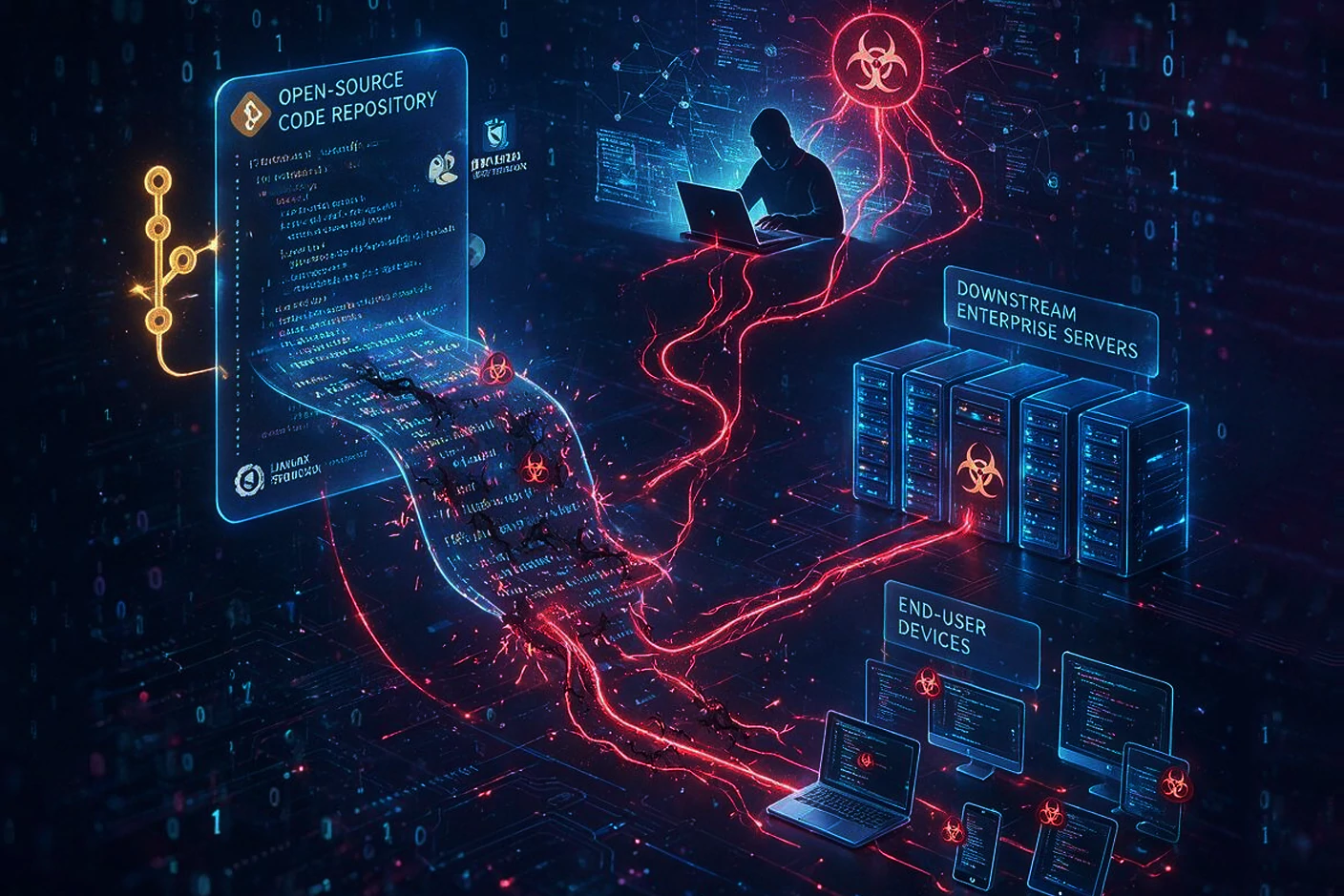
A software supply chain attack doesn’t go after a business straight on. It targets something the business already considers safe, such as a package, a library, a build tool, or an update process that lives somewhere between a developer’s editor and the final shipped product. The National Cyber Security Centre has pointed out that attackers are targeting open-source packages more to quietly spread malware using the reach of one very broadly used dependency and basically touch every project that pulls it in. When the malicious code ends up inside a trusted registry, the downstream work inherits it automatically, often without anyone doing the proper review.
Why Small Teams Are Easy Targets
People often assume the biggest organisations get hit first, but the mechanism itself does not really care about the size of a company. Most businesses have had a cybersecurity breach or attack in the past 12 months, with only a few reviewing the cyber risk their immediate suppliers pose and looking further along the chain. Small development teams who balance multiple client jobs and lack a dedicated security role usually sit right in that blind spot. Attackers know it too. A team can have solid coding habits and still be compromised because they didn’t establish a formal process for reviewing dependencies. So, the malicious package they never wrote can still be the one that breaks everything. For a small agency doing software for several clients at once, it can get worse. One compromised dependency that is shared across projects can affect multiple clients at the same time. Also, one overlooked update can basically turn into several separate incidents, and they don’t all look connected at first.
Hidden Risks in Trusted Dependencies
Most modern apps stand on dependencies that most developers do not read all the way through. As a result, the most common attack styles group into a few distinct buckets:
• Package compromise, with malicious code introduced into effective open-source libraries.
• Build pipeline compromise, where the compilation tools are tampered with without any direct change to the app.
• Credential theft, meant to grab publishing access to a trusted package.
• Self-propagation, where access earned through one compromised package is used to reach other places, spreading the issue across an ecosystem.
None of these requires the attacker to break into the target’s own systems. They have to push into something the target already treats as unquestionable. Identifying a compromise early does not require expensive tools but rather a habit that development teams usually lack in the first place.
Early Warning Signs
Catching a compromise early usually has less to do with fancy, expensive tooling and more to do with routines that many small teams do not follow. A couple of simple starting points to consider are the following:
• Keeping a current software bill of materials, basically a list of every dependency the project truly relies on.
• Reviewing changes and updates in version and package rather than accepting them blindly.
• Paying attention to dependencies that show up suddenly, or for no clear reason in particular.
• Monitoring odd activity inside CI/CD pipelines, because build systems are often an obvious target.
• Rotating credentials right away if compromise seems even a little likely, not waiting for full confirmation.
None of this really needs a giant security team. It is more about recognising that dependency management is a normal part of development work, not something to check now and then when time allows.
Ownership and Accountability
Responsibility for supply chain risk in small teams can get ambiguous. It ends up between everyone’s job and nobody’s job until an incident makes the question loud. Recenturesoft Infotech treats dependency review more like project planning than some separate security work to tack on later. It is a simple concept: any vulnerability has the same overall impact whether it is coded by the in-house team or designed by a third party. Clear ownership, even if it is informal, is really crucial. This helps blur the gap between a team that notices an unpredicted dependency swing within days and another that realises it when a client brings it up, often months later. In everyday practice, ownership can be as plain as assigning one person per project who actually approves new dependencies before they get pulled in, rather than the person doing the coding that day.
Conclusion
Software supply chain attacks win by leveraging trust rather than punching through defences; that is also why small teams get hit as much as big enterprises. Software can use several dependencies irrespective of the size of the company. What changes the result is whether a team is actually watching those dependencies, and treating that watchfulness as routine, not optional, is what tends to catch things early.